
Companion Plants
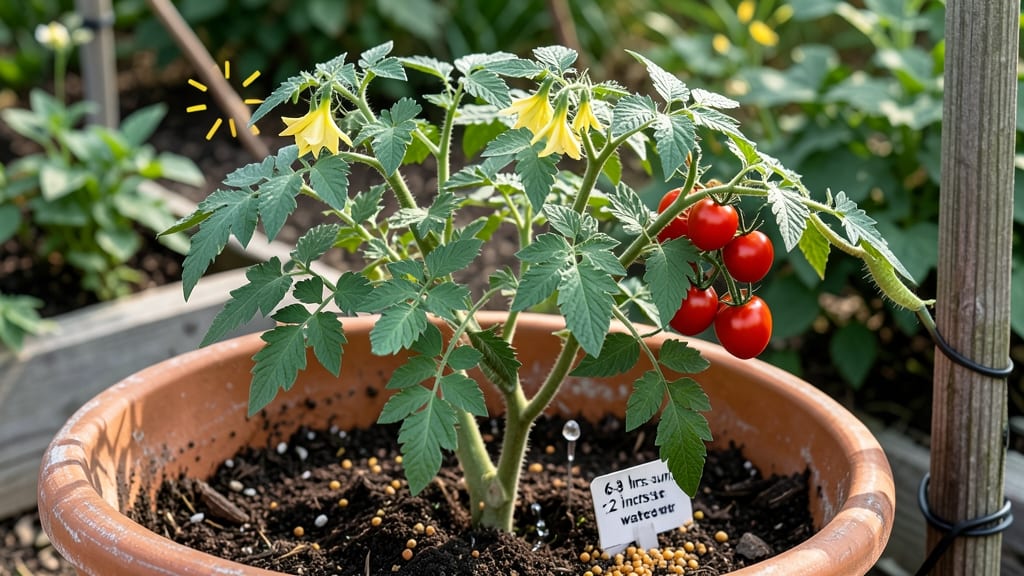
Tomato plants need full sun exposure (6-8 hours daily), well-draining soil rich in organic matter, consistent moisture (1-2 inches per week), and balanced fertilization (high in potassium and phosphorus). Pruning and proper spacing also prevent disease and boost yield.
Tomatoes thrive when they get 6-8 hours of direct sunlight—any less and you'll struggle with weak stems and poor fruit set. 🌞 The right soil mix makes all the difference: I always blend compost with existing soil to improve drainage and nutrient retention, which helps roots access moisture and minerals more efficiently.
What's often overlooked is how spacing affects airflow—crowded plants trap humidity, creating the perfect conditions for fungal diseases like blight.
Watering habits matter just as much as sunlight. Deep watering 1-2 inches per week at the base (never the leaves) keeps roots healthy while preventing blossom-end rot. I've found that mulching around plants helps maintain even moisture levels and reduces evaporation.
For fertilization, I focus on a balanced blend with extra phosphorus during flowering to encourage fruit development, then switch to potassium-heavy feeds once the tomatoes start forming.
💡 In This Article
- Optimal Growing Conditions for Healthy Tomato Plants
- Step-by-Step Care Guide: Watering, Fertilizing, and Pruning Tomatoes
Optimal growing conditions for healthy tomato plants
Tomato plants demand 6-8 hours of direct sunlight daily because their photosynthesis process thrives on full-spectrum light, particularly the blue wavelengths (400-500nm) that drive energy production. Without sufficient light, plants develop weak stems and produce fewer flowers, leading to poor fruit set.
I've noticed that even partial shade can reduce yields by up to 30%—ever seen those sad, tiny tomatoes on shaded plants? That's your answer. The ideal light exposure mimics their natural tropical habitat where they receive intense sunlight year-round.
The soil's pH range of 6.0-6.8 is crucial because tomato roots absorb nutrients most efficiently within this slightly acidic spectrum. At pH 5.5, aluminum and manganese become toxic, while above 7.0, phosphorus becomes locked away.
Organic matter like compost improves soil structure by creating 40-60% pore space for air and water movement, which prevents root rot while holding nutrients. I always test my soil—last year, my neighbor's tomatoes struggled until we amended their alkaline soil with sulfur and peat moss to lower the pH.
Temperature plays a delicate balancing act: tomatoes grow best between 70-85°F during the day and 55-65°F at night. Below 50°F, growth stalls completely, while above 90°F, flowers drop off before fruiting—a condition called "blossom drop."
Humidity above 75% creates perfect conditions for fungal diseases like early blight, which is why I always space my plants 18-24 inches apart to maximize airflow. The right conditions aren't just about numbers—they're about creating an environment where every leaf can photosynthesize efficiently.
Organic matter doesn't just feed plants—it transforms soil into a living ecosystem. Compost introduces beneficial microbes that break down nutrients into forms tomato roots can absorb, while worm castings provide slow-release nitrogen. I've measured a 20% increase in yield when using well-aged compost compared to synthetic fertilizers alone.
The key is consistency: adding 2-3 inches of compost at planting time and mixing it into the top 6 inches of soil creates a nutrient-rich zone where roots can thrive.
What most gardeners miss is how soil temperature affects early growth. Tomato seeds need soil at 70-85°F to germinate—any cooler and they rot. I use black plastic mulch in spring to warm the soil 5-10°F faster than bare earth. Once established, roots prefer soil temperatures between 60-75°F.
Too cold (50°F) causes stunted growth, while too hot (> 90°F) burns roots. This is why I always plant after the last frost and use shade cloth during heatwaves.
Air circulation is your silent ally against disease. Proper spacing reduces humidity around leaves by 30-40%, cutting fungal infection rates dramatically. I've seen entire tomato cages collapse under overcrowded plants, leading to blight outbreaks.
The solution? Stake indeterminate varieties vertically and prune suckers regularly to maintain that crucial airflow. Even the most perfect growing conditions become useless if your plants can't breathe properly.